

A human being wrote this article, and by reading and engaging with it, you are supporting LeDavid DeLouis’s lifelong writing pursuit. Thank you! 😁📚
Editing Kills Chaos
by LeDavid DeLouis
Note: This is a chapter from my upcoming nonfiction guide:
Editing! | Refine Your Editorial Workflow. Enjoy!
Khaoz
“Order is a law of nature; Chaos is the torment of man.”
—antagonistically adapted from Henry Adams
Throughout our universe, there are two opposing forces battling: Khaoz and Order. And as mere mortals, we are caught between them.
Khaoz noun
The natural force and state of disorder, confusion, and unpredictability that causes us harm.
Though this may be the first time you’re hearing of “Khaoz” as I spell and describe it, I assure you that you are already more than familiar with the force because of its many powerful effects on your (and everyone else’s) day-to-day life.
I have carefully chosen to refer to it as “Khaoz” and not the traditional term “chaos” because I don’t want you to think of this force in the traditional sense, as something inanimate and vague. I’d rather you, like me, develop a visceral disgust of Khaoz, so you can better recognize its infinite tendrils of negative influence that permeate our world.
You are alive today because your ancestors tended to mistake a rock for a bear, but never a bear for a rock, because the latter mistake would get them quickly killed. In the same way, I want you to recognize, tangibly, the hungry, dangerous force of Khaoz.
The term Khaoz should sound harsh to you because of the Bouba-Kiki effect, and its spelling should seem disconcerting, like it has been misspelled. I intend these effects because Khaoz ought to be recognized as bad, and something we’re to work against.
Khaoz is both a force and state, and the adjective for it is “khaotik.” A singular instance of Khaoz is a “kain,” and multiple instances are “kainz.” (Notice again how the spelling of kainz may inspire discomfort...) A useful mnemonic to remember this term is: “a pain, a stain, a kain.”
I primarily derived the word kain from Celtic and Welsh traditions, where it means “warrior” or “battle.” In Scottish and Old English, “ane” means “one,” and that denotes that each kain is a single instance of Khaoz. The term is also a reference to the Biblical Cain, whose name in Hebrew is “Qayin”, which means “possession” or “spear.” This Cain was the world’s first murderer, according to the Bible, when he killed his brother, Abel, out of jealousy and anger after God favored the offering of Abel’s best flock over Cain’s crops. The weapon Cain used to slay his sibling is unspecified, but a rock is one of the popular theories.
A khaotik kain is like one warrior of Khaoz in the battle between it and Order, as each kain permanently alters the rest of history and the entire universe—which we believe to be true because of Chaos Theory, a.k.a. “The Butterfly Effect.” Each kain is Khaoz gaining territory, more “possession” of our reality, and thus a kain is akin to a spear-point being driven into each of us.
Examples of Khaoz and kainz you’re familiar with include:
the 7 Deadly Sins: Pride, Greed, Lust, Envy, Gluttony, Wrath, Sloth
unwanted distractions, procrastination, bad habits
“Writer’s Block,” typos, imperfections, lies
disorderly conduct, vandalism, arson, theft, fraud, embezzlement, robbery, DUIs, assault, rape, suicide, murder
bills, traffic, brain fog, obesity, unwanted fat, rude remarks
stress, anxiety, depression, self-doubt…
And on and on. If it is generally “bad for you” and your ideal life lacks it, then it is almost certainly Khaoz, khaotik, or a kain.
(In Steven Pressfield’s books, he refers to a similar concept called “Resistance.” Rick Rubin’s book The Creative Act also refers to another similar concept that he calls “interference.”)
I encourage you to develop a person symbol for Khaoz and kainz that will resonate deeply with you, whether that symbol be a person, place, or thing. For example, you may personify Khaoz as Christianity’s Satan or Hell, or a monster from literature, like H.P. Lovecraft’s Cthulhu or Stephen King’s IT. The Ancient Egyptians depicted Apophis, a deity of chaos, darkness, and fire that opposed order, light, and truth, as a vicious, colossal serpent. Apophis was fought by their deity Set before Set himself became a god of chaos and deserts, storms, disorder, violence, and foreigners. Norse mythology features Jörmungandr, a.k.a. the apocalyptic World Serpent, who grows so large as to surround the entire world and bite his own tail.
I imagine Khaoz to be an invisible, incomprehensibly demonic and eerie spider titan that crawls along webs amidst the shadows and cracks of our reality, forever vengeful because the universe and life’s existence disrupted its otherwise endless slumber in the perfect, peaceful, primordial abyss. The spider titan speaks in guttural, chittery tongues that appear to our mortal ears sweet and loving, like a siren song drawing us all closer to personal Hells we ourselves create. And we lose a small piece of our higher selves when we inevitably slip-up and follow that song, which guides us like flies to a web waiting to ensnare us, and where the arch-backed arachnid waits to feast on our flesh.
I think of Khaoz to this absurd degree because, while my symbolic concept of the force may be imagined, the consequences and harm of Khaoz are utterly real. And to prevent them, there must be something more tangible for us to fear and fight against.
So give Khaoz an abhorrent face and a body you’ll remember as you go on to kill it.
Order
“Even in perceived chaos, there is order and pattern. A cosmic undercurrent running through all things, which no story is immense enough to contain.”
—Rick Rubin
Thankfully, we have the universal force of Order to defend ourselves from the harm of Khaoz. Order that we may wield or support in this battle of life we live.
Order noun
The natural force and state of organization, understanding, and function that enhances our existence.
The force of Order supports us and our work as a positive, coherent feature of consciousness and life that naturally desires to grow in essence. Like a mother breastfeeding her daughter, or like a father teaching his son to hunt, so that they may all thrive and proliferate as both individuals and a family.
Order wants us to bring about more Order because Order is the preferable state for conscious life, and it is only conscious life capable of discerning the fluctuations of energy and matter in our universe. Naturally, the universe is like one great being sick with Khaoz, and the conscious beings of that universe ought to heal it via Order just as cells of the human body try to heal us of diseases, so that we and all of our cells will more so thrive in our shared being.
(Are we so naive as to believe that we are the highest form of consciousness that exists in the universe when we ourselves are made of trillions of living cells and bacteria, and despite our coming together, much like cells, to form super-human teams, families, corporations, nations, and the human race, all so much more capable of thought, feelings, and actions than us as individuals?… Gee, I sure hope not.)
Unlike Khaoz, I have decided to refer to Order in its traditional form because I wish for it to feel familiar and comforting, and because, likely, you already understand Order quite intuitively. After all, it is Order of consciousness that we tend to chase all day every day, though we may do so incorrectly by falling for the pleasure trap-tricks laid by Khaoz.
The adjective for Order is “orderly,” and instances of Order are “ords.” A useful mnemonic to remember this term is: “an award, an accord, an ord.” I derived the word ord from Latin “ordinem,” which means “row, line, rank; series, pattern, arrangement, routine.” Ord is also an Old English noun that means “point, spear-point, beginning, source, vanguard,” stemming from the Proto-Germanic “uzdaz” that refers to the sharp tip of a weapon, or the edge of something.
As instances of Order, ords oppose kainz, and you may find joy by, like me, identifying and appreciating them in your day-to-day life. For example, you may think to yourself, “Ah, that’s an ord!” when you’re running late to work but all of the traffic lights you encounter turn green before you reach them, or when a friend you’ve been missing unexpectedly reaches out to you, or when a pleasant day’s warm, bright sunshine softens your worries. All of these are tangible instances of the universe physically aligning with your desires in a positive, orderly way!
Other examples of Order and ords you’ll recognize include:
the 7 Heavenly Virtues: Chastity, Temperance, Charity, Diligence, Kindness, Patience, Humility
focus, discipline, good habits
the flow state, improvements, perfection, truth
laws that effectively prevent human acts of Khaoz
relief, relaxation, energy, fitness, compliments
pleasure, safety, happiness, confidence…
And on and on. If it is generally “good for you” and your ideal life contains it, then it is almost certainly Order, orderly, or an ord.
Just as I encouraged you to symbolize Khaoz, I also recommend you envision Order as a person, place, or thing. For example, as the Christian concepts of an all-loving God or Heaven, or the fundamental Stoic principle of Logos. Or Order to you may be the relationship you share with a beloved pet, or your dream life with all things as best as they possibly could be. I symbolize Order as a Heaven within which I, friends, family, pets, and all the other conscious beings of the world are able to thrive and coexist in creative harmony, with ample love, resources, time, energy, appreciation, and a variety of experiences.
Whether such a state of being is physically possible or sustainable in our reality is a matter worthy of deep philosophical contemplation and scientific experimentation. But regardless, we ought to strive to bring such Order about, and to enjoy ourselves on our journey toward that hypothetical destination, because, really, what’s a preferable alternative?
By supporting Order and suppressing Khaoz, we directly enhance our universe and conscious experiences of it.
Khaoz vs Order
Khaoz noun
The natural force and state of disorder, confusion, and unpredictability that causes us harm.
Order noun
The natural force and state of organization, understanding, and function that enhances our existence.
To summarize, both Khaoz and Order are universal forces that permeate our reality, and it is our duty as conscious, creative beings to support Order and suppress Khaoz. Both are subjective—“What is normal for the spider is chaos for the fly,” as Charles Addams said—yet meaningful because of their profound effect on the quality of our conscious experiences.
(One may argue that transcending experience itself is more important than supporting Order, but I’d argue that transcendence is also Order, just of the self or consciousness rather than the “external world,” which our consciousness is a part of.)
Here are more examples of Khaoz and Order side-by-side to further solidify the two opposing forces and their aspects in your long-term memory:
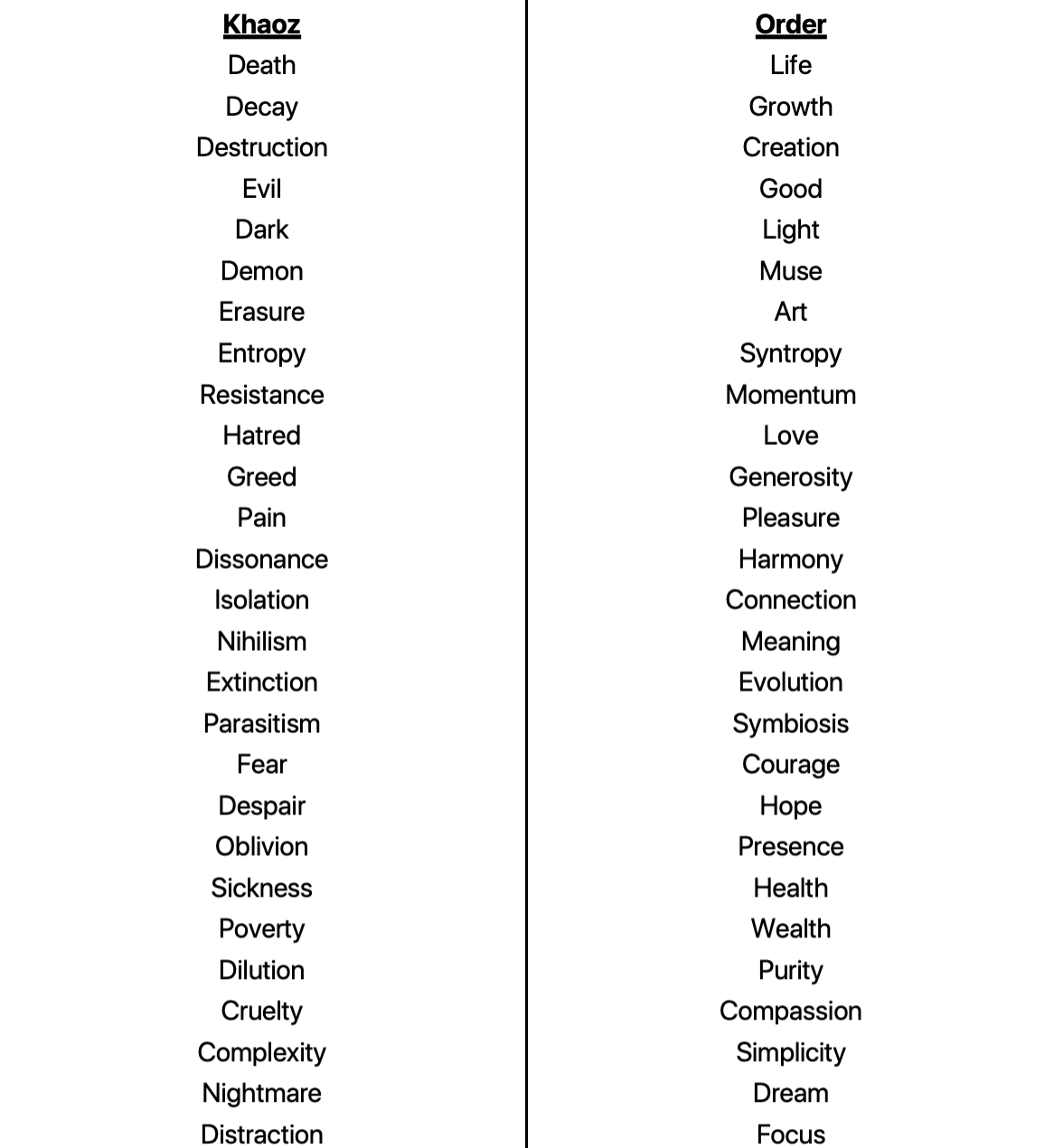
Interestingly, Khaoz trends toward a state of perfect Order over great spans of time via entropy, erasure, and ultimate oblivion, assuming that our current understandings of cosmology and the Heat Death of the universe are accurate. As conscious beings affected by dynamic matter, energy, and time, however, we’ll want to maintain a minimal amount of Khaoz to avoid perfect Order, which seems to be a null state devoid of any life or consciousness.
Our Influence
“The task of art today is to transform chaos into order.”
—antagonistically adapted from Theodor W. Adorno
As incredibly capable, conscious beings, our behaviors have widespread effects on the lives of so many others and the Khaoz or Order they too will experience.
For example, consider the self-immolating terrorists who crashed passenger planes into the Twin Towers and injected immense Khaoz, death, and destruction directly into the lives of thousands of victims. Hundreds of millions of people still suffer today because of the tragedy’s lasting grief and horror.
Oppositely, Norman Borlaug, “the father of the Green Revolution,” is credited with saving over a billion people from starvation with his development of semi-dwarf, high-yield, disease-resistant wheat varieties. In 1970, he was awarded the Nobel Peace Prize for his contributions to world peace by increasing food supply, and in 2009, the Executive Director of the World Food Programme, Josette Sheeran, stated that Norman “saved more lives than any man in human history.”
Recognize for a moment the incomprehensible difference in khaotik and orderly impact these few men had on the world today, especially on the lives of those innocent victims who were forced to plummet or burn, and on the hundreds of millions of beneficiaries who’d have slowly starved or fought to death without Norman’s life-saving agricultural work. These few men’s past actions will continue to ripple out and affect the rest of human history for all-time.
(I have cited two extreme examples, against which you may mistakenly deem editing merely trivial, or even inappropriate… However, it is precisely these extreme benefits of Order or consequences of Khaoz that eventually arise from our cumulative, daily, more mundane behaviors, such as editing.)
…
Now consider your favorite author and the sense of pleasure you experience when reading their works. A skilled author brings Order to our usually khaotik consciousness as we spend hours reading, understanding, and enjoying their writing, to where they may seem like a distant, lifelong friend. That author whose work you love may also be like a friend to millions of others, resulting in an immeasurable, positive impact on the world. An author’s influence, whether beneficial like Borlaug’s or terrible like the terrorists’, also ripples through all the rest of time and reality.
As does, of course, your influence, because any decision you make alters the universe in a manner that physically cannot be undone. You cannot unbrush your teeth, or unsay an insult, or re-eat a meal. “No man ever steps in the same river twice, for it’s not the same river and he’s not the same man,” as Heraclitus said, because the small, seemingly innocuous effects of our behaviors—like brushing our teeth, speaking our minds, and eating our meals—compound, continuously changing us and all of the complex world, similar to how a tiny butterfly’s wing flaps may alter the cascading variables of weather to cause or negate a cataclysmic tornado.
You have the opportunity to flap your wings such that a tornado won’t appear, as you’re able to suppress Khaoz and support Order with behaviors like editing your written works. To carefully curate your writing, refine away imperfections, and purify a piece according to your subjective vision of Order is, therefore, literally life-changing work.
…
How might our world be if no one edited, ever? And how might we get along if our laws, instruction manuals, textbooks, white papers, academic journals, holy texts, masterpieces of literature, screenplays, documentaries, nutrition labels, advertisements, and nonfiction guides had never been edited, or had been poorly edited? Our day-to-day lives would be unrecognizably more khaotik and painful, and so much less civilized and beautiful, without the editing efforts of many.
Thus, I pose to you: As a curative crusader and a literary legionnaire blessed by modern life’s amenities and information access, will you take up this call to cultivate your editorial prowess and kill, word by word, the wicked viciousness of Khaoz that plagues our written works?
Sincerely, your writer friend,
LeDavid DeLouis